
On Sunday I will be running the Cologne Marathon. I am full of excitement and anxiety, like I have been before all my marathons.
In an attempt to alleviate my anxiety I have mined my Strava history, using the amazing rStrava package, which allows me to dig properly deeper into my training and racing history.
In my typical obsessive fashion I have now looked at this data in every single possible way. I will not present any of the too-nerdy stuff here, but I figured I’d tell you about the man with the hammer.
The Wall
Many Germans, my trainer included, do not call the wall the wall. Instead they call it the Man with the hammer or simply “Der Hammermann”. This metaphorical man tends to wait for marathon runners late in their marathon and mess with their hopes and dreams of a PB.
Most runners have met this hammering man and I am no exception. In fact I have been slammed down by this asshole in three out of five marathon races I have competed in (in the other two, I was the one responsible for my own abysmal result).
Let me show you a graph.
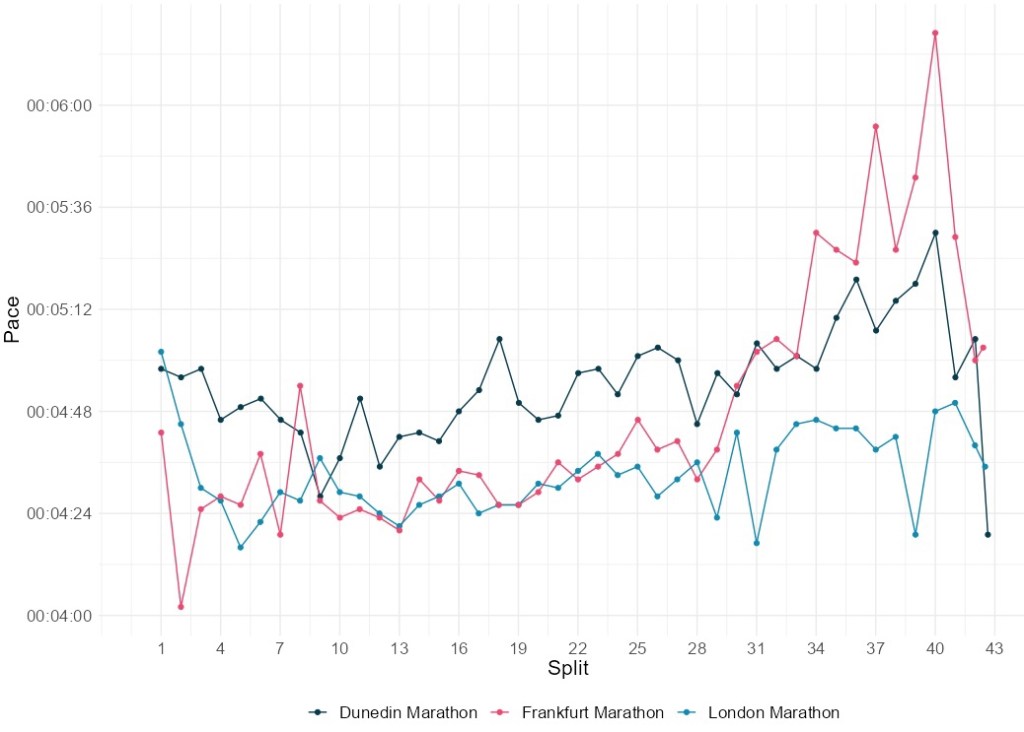
The graph above shows the average tempo per km broken down by race. It only contains three races, my first race I do not have data for and Boston was just too bad to include. I just looks like a COVID-19 dashboard-chart from 2020.
If you have a good eye for data you might actually be able to see the point in which Der Hammermann shows up. Around 28-32 km. But if you are anything like me, I am sure that eyeballing is not enough. You also need some regression results with stars above p-values.
So, to satisfy myself, and any nerd that has read this far, I came up with a simple econometric model where I estimated the impact of elevation, split number (cumulative KMs) on my average pace. Finally I added in a variable that I varied across the splits to try and find out at what point I am expecting Der Hammermann on Sunday.
For each model run I (lazily) looked at the R2 and used that to find at what split I could best predict the outcome each of the three races. For you nerds out there, here is a chart showing the R2 statistic (goodness of fit) depending on where I place the dummy. And it looks like Der Hammermann arrives, in my case, around the time I have 10 km left to run.
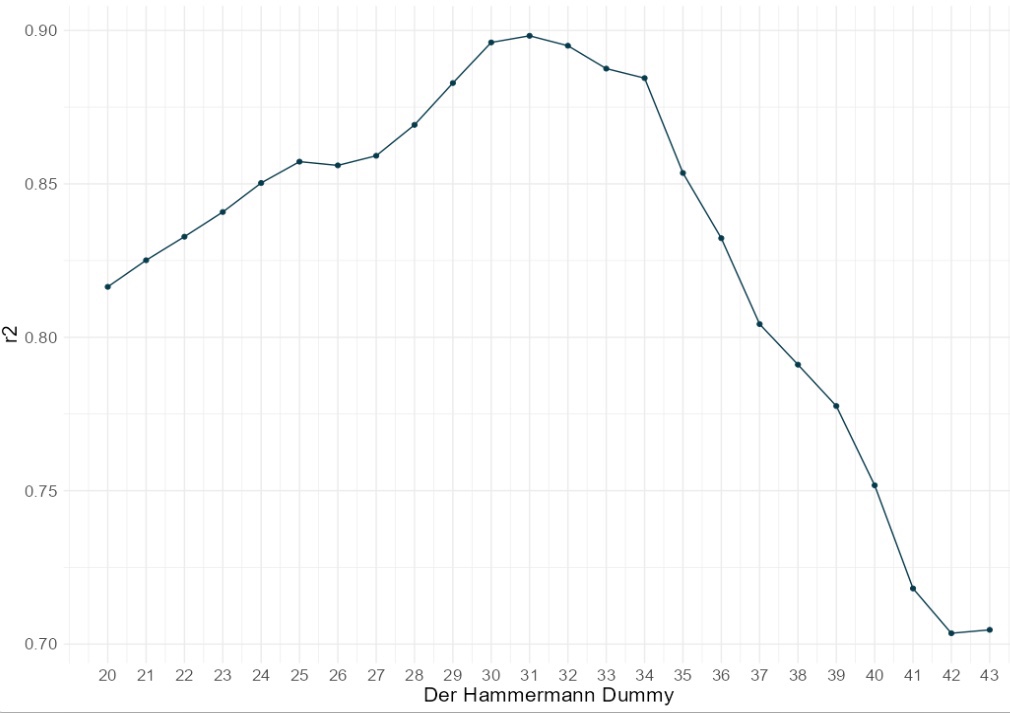
This model seems to suggest that Der Hammermann claimed no less than 2 minutes and 30 seconds of my time in Dunedin, probably around 1 minute 30 seconds in London and a whooping 7-8 minutes in Frankfurt.
See you on Sunday. You stupid Hammermann.
 Eikonomics
Leave a comment